A Simple Guide
Paul Thomas
Church House Publishing, 2012.
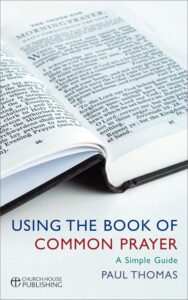
When Paul Thomas wrote this he was a vicar. He is now Bishop of Oswestry.
Part 1 is a historical introduction. It is an excellent, clear explanation of the intertwined theological and political debates of the time. It summarises the evolution of the different versions: 1549, 1552, 1559, 1604 until it reached its final form in 1662.
“Under the terms of the 1559 Act of Uniformity it was a criminal offence not to attend church each week, and while at church it was an offence not to use the new Book of Common Prayer.” Page 41.
Perhaps it would be fun to reintroduce that law. It would solve the church’s attendance and funding problems!
Part 2 is on using the Book of Common Prayer. He has chapters on: Morning Prayer (Matins); Evening Prayer (Evensong); Holy Communion; Baptism; Holy Matrimony; and Burial of the Dead.
This book is written normally assuming that the reader is a member of the clergy wanting to know how to lead BCP services. It doesn’t guide lay people wanting to use the BCP in their personal prayers.
In the chapter on Holy Communion, he explains:
“The Prayer Book has written within its covers all you need to conduct a service of the Holy Communion. This was Cranmer’s ideal; he objected to the number and complexity of the books required to lead any service in his own time and so composed a book that stood alone. That is why he incorporated all the necessary readings for Communion into the Book of Common Prayer. This means that for every Sunday of the year and for many feast days throughout the year, a complete set of readings is provided with an accompanying collect.” Page 91.
It is nice that in today’s multi-media and resource overload, one book is all you need.
And, not all of it has to be used:
“I would suggest you try not to make a habit of declaring excommunications at the Communion!” Page 94.
“Don’t feel that every word has to be said. This is often the mistake of those who use the Prayer Book. Take some time to read and become familiar with the service in advance. Know which parts of the service are essential and which not.” Page 115.
In the chapter on baptism he writes that the simplicity of the service is its strength:
“It contains none of the symbolism of more recent Baptism services. In fact it came about precisely because Thomas Cranmer and others wanted to get back to something more ‘primitive’ (authentic) and felt that the proliferations of ceremonies and symbols surrounding the sacrament of Baptism had succeeded in obscuring its meaning. For that reason, the Book of Common Prayer Baptism service was stripped of those now recently revived ceremonies in favour of a straight-speaking theology of fallen human nature and salvation through grace alone. That theology of fall and redemption is presented within a simple structure and is accompanied by the clear exhortation for every baptised person to live a serious and devout Christian life.” Page 115.
When it comes to the chapter on Holy Matrimony, the author loses his nerve. He keeps suggesting replacing parts of the Book of Common Prayer service with the 1928 ‘Series One’ service. This rather goes against the title of the book, which is how to use the BCP, not how to replace it.
Sadly, this book only covers the main services. There are many riches in the BCP that are not touched upon. Having read the whole of the BCP recently, here are some prayers I liked from the BCP itself:
In “A Commination”:
“receive and comfort us, who are grieved and wearied with the burden of our sins. Thy property is always to have mercy” BCP, page 345.
In “The Ordering of Deacons”:
“We humbly beseech thee, O Father, mercifully to look upon our infirmities; and for the glory of thy Name turn from us all those evils that we most righteously have deserved; and grant that in all our troubles we may put our whole trust and confidence in thy mercy, and evermore serve thee in holiness and pureness of living, to thy honour and glory; through our only Mediator and Advocate, Jesus Christ our Lord. Amen.” BCP, page 563.
In “Forms of Prayer: with thanksgiving to Almighty God”
“A Prayer for Unity.
O God the Father of our Lord Jesus Christ, our only Saviour, the Prince of Peace; Give us grace seriously to lay to heart the great dangers we are in by our unhappy divisions. Take away all hatred and prejudice, and whatsoever else may hinder us from godly union and concord; that, as there is but one Body, one Spirit, and one hope of our calling, one Lord, one faith, one baptism, one God and Father of us all; so we may henceforth be all of one heart, and of one soul, united in one holy bond of truth and peace, of faith and charity, and may with one mind and one mouth glorify thee; through Jesus Christ our Lord. Amen.” BCP, page 598-9.
In “Forms of Prayer to be Used at Sea”
“O Most powerful and glorious Lord God, at whose command the winds blow, and lift up the waves of the sea, and who stillest the rage thereof: We thy creatures, but miserable sinners, do in this our great distress cry unto thee for help: Save, Lord, or else we perish. We confess, when we have been safe, and seen all things quiet about us, we have forgot thee our God, and refused to hearken to the still voice of thy word, and to obey thy commandments: But now we see how terrible thou art in all works of wonder; the great God to be feared above all: And therefore we adore thy Divine Majesty, acknowledging thy power, and imploring thy goodness. Help, Lord, and save us for thy mercy’s sake in Jesus Christ thy Son, our Lord. Amen.” BCP, page 539.
That last prayer may come in handy if I ever go on a cruise!
Adrian Vincent.
March 2026.