Bring on the Girls; Performing Flea; Over Seventy.
P. G. Wodehouse
Copyright 1957, Penguin 1981.
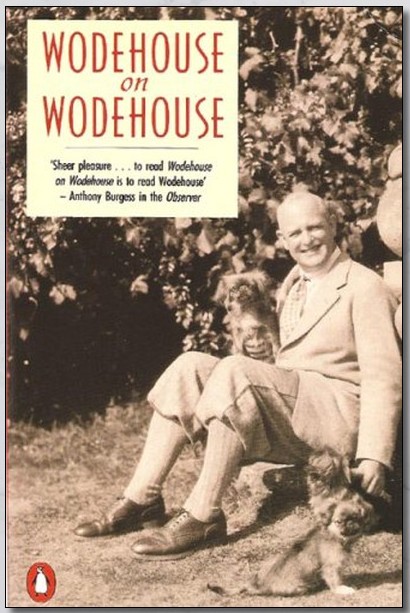
This is a collecton of P.G. Wodehouse’s (pronounced ‘Woodhouse’) three autobiographical books. Perhaps better described as collections of anecdotes, because he thinks no one would be interested in his life as a writer, sat at his desk typing away for hours every day.
The first book “Bring on the Girls” is from his early days as a lyric writer for musicals.
“Performing Flea” is the best because it includes exerpts of his diaries as an internee during the Second World War.
“Over Seventy” is light fluff of his observations on America. For example:
“The American Christmas is very different today from what it was when, a piefaced lad in my twenties, I first trod the sidewalks of New York. Then a simple festival, it now seems to have got elephantiasis or something. I don’t want to do anyone an injustice, but the thought has sometimes crossed my mind that some of the big department stores are trying to make money out of Christmas.” Page 633.
“Performing Flea” includes his being arrested in 1940 by the Germans in France where he had been living. All men under 60 were taken to internment camps. He was moved through several locations, including Fort Huy in Belgium, where, even when writing of his difficult conditions, he can’t help writing with a light touch, and he has no animus towards his captors:
“August 13th [1940]
I have now been sleeping for ten nights without a blanket, and it gets bitterly cold at night at this height. Today I went to the Sergeant, accompanied by Enke, our linguist, and complained. The Sergeant was apologetic, but it seems there are no blankets. His attitude seemed to be that you can’t have everything. […]
The German soldiers themselves are all right. Being cooped up with them in this small place, we see a lot of them and they are always friendly. They are all elderly reservists longing to get home to their wives and children, whose photographs they constantly show us, and they sympathize with us.” Page 420.
He is then transferred to an internment camp in Tost (now named Toszek, in Poland). The first night:
“we found that we had got to sleep on the floor. And if anybody wants a testing experience, let him travel for three days and three nights on hard wooden seats in a crowded compartment of a train and then turn in for the night on a cold stone floor. In the little brochure which I am preparing, entitled ‘Stone Floors I Have Slept On’, this one at the White House at Tost will be singled out for special mention.” Page 434.
The next night the internees are moved into dormitories where they do have beds:
“The room had originally been designed to accommodate thirty, which made sixty-six a nice cosy number by internee standards.” Page 437.
When his fellow internees in his dormitory were arguing, he writes:
“It was exactly like the sort of squabble one used to have in a junior dormitory at school, and when you consider that nobody taking part in it was under the age of fifty, I think it does us credit. Internment may have its drawbacks, but it certainly restores one’s youth.” Page 439.
It is often said that Wodehouse never really grew up.
He was released from the internment camp in 1941 because he was about to turn 60, and was duped into broadcasting from Germany some funny stories about his camp experience, which got him in terrible trouble in England.
In 1944 he was living in Paris which had recently been liberated. Wodehouse writes to his friend Bill Townend.
“Hotel Lincoln, Rue Bayard, Paris. December 30th, 1944.
[…] My arrest by the French came as a complete surprise. I have it from what is usually called a ‘well-informed source’ that an English woman was dining with the Prefect of Police, and said to him, ‘Why don’t you arrest P. G. Wodehouse?’ He thought it a splendid idea and sent out the order over the coffee and liqueurs, with the result that I woke up at one o’clock in the morning of 22nd November to find an Inspecteur at my bedside. […] He took Ethel and me to the Palais de Justice, where we spent sixteen hours without food in a draughty corridor, sleeping on wooden chairs.
[…] Next day they released Ethel, and I spent four days in the Inspecteur’s room, getting very matey with them all and resuming work on my novel.” Page 354-355.
Whether he was in a German interment camp or a French police station, he carried on writing his books seemingly unaffected by his surroundings. When reading his books today, you can’t tell which ones were written before, during, or after the War. They are all loveable amusing stories of an uncomplicated world that we probably wished we lived in, providing a wonderful break from our troubles.
April 2026
Adrian Vincent