An Unlikely History of the Buildings That Made Christianity
The Reverend Fergus Butler-Gallie
Hodder and Stoughton, 2025.
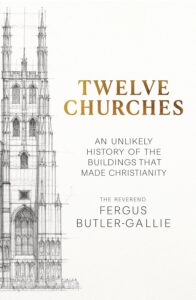
The Revd Fergus Butler-Gallie is one of my favourite authors. He writes in an entertaining style combined with depth of knowledge and insight. As someone interested in church buildings I was really looking forwarded to reading this.
My first disappointment came on being misled by the picture on the cover, which shows a detailed architectural drawing of a church. Inside the book all you get is a rough sketch of each church, which looks like it was drawn by a child. No plans or photos.
The next disappointment is that the book isn’t really about twelve churches. Each chapter is entitled the name of a church, but after a short description, it is used as jumping off point to explore a particular theme.
For example, chapter six, “Bete Golgotha, Lalibela, Ethiopia”. Whole books have been written about the rock carved churches of Ethiopia. Fergus could have written a fascinating chapter on this church. Instead, after a few pages describing the building and its history, he then crams into the next eleven pages: the Irvingites in London; the Roman Empire; the Czech church in the eleventh century; Charlemagne in Germany; England in 1208; the Archbishop of Canterbury; Venice in 1604; Moscow in 1655; his local church today; 1572 Dutch town of Gorkum; and Devon in 1520. All are connected to his theme for that chapter which is on attempts to build a ‘new Jerusalem’. Jumping all round the world, forward and back in history was dizzying and frustrating.
Fergus would be perfectly capable of writing a longer account that draws you into an event, without jumping around so much. Chapter 11, “16th Street Baptist Church, Birmingham, Alabama, United States of America”, he writes engagingly and movingly on what happened when that church was bombed by the Ku Klux Klan in 1963. But, he only gives a short account and is off again to other locations and histories.
Within the book are valuable spiritual insights:
“The irony is, of course, that for all the times Christianity led the way in inflicting or at least justifying violence, it also played a pivotal role in making the West less violent over the years.” Page 123.
“purity of heart is best achieved not by attempting to force external conformity on others, but by focussing on the failings which we exhibit ourselves.” Page 291.
There is only one comment in the book where I think he is wrong:
“one can convincingly argue that the language of sexual rights of the individual goes back to Paul. […] the abortion slogan of ‘My body, my choice’ has its origins […] in Paul’s idea that the body was a temple and worthy of consideration over what was done to it.” Pages 165-6.
What St Paul actually writes, in 1 Corinthians chapter 6 verse 19, is:
“do you not know that your body is a temple of the Holy Spirit within you, whom you have from God? You are not your own”
This is the opposite of ‘my body my choice’.
I am not good obeying God’s claim on my body – I love to eat junk food – but I don’t misuse St Paul to justify my bad behaviour!
March 2026
Adrian Vincent